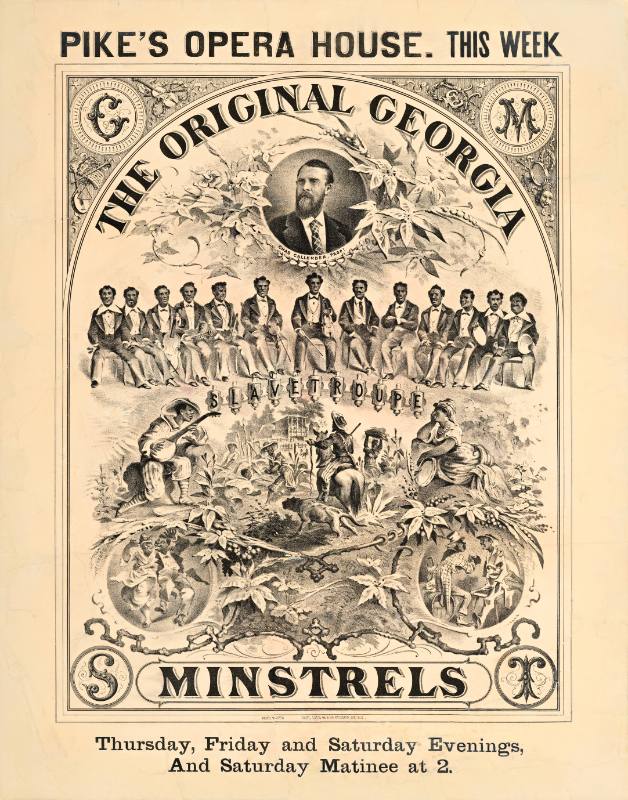
Formed by Black manager Charles B. Hicks in 1865, the Georgia Slave Troupe Minstrels (promoted under several similar names over the years) was the first popular all-Black minstrel troupe composed of formerly enslaved men. Hicks promoted his troupe as “authentic” minstrel performers, presenting plantation narratives with brown-skinned men in blackface. In 1872, Hicks sold his company to Charles Callender, a white man who had worked on the show as part of Hicks’s team. Following the Civil War, the words “Georgia” and “Dixie” became synonymous with blackface minstrelsy in theater, representing the South and a nostalgia for plantation life. As such, these words were often included in minstrel posters even if the troupes themselves were neither from Georgia nor the South. These images evoked the myth of the Lost Cause, an interpretation of the Civil War that portrays the fight of the Confederate States as honorable and just while rejecting or decentering the critical role of the institution of slavery. As in most circus and vaudeville advertising of the time, the proprietor’s portrait is featured in a cameo at the top of the poster. Below him, the 13 members of the original minstrel troupe are shown in matching formal costumes, their individual facial features barely distinguishable. This juxtaposition reinforces a sense of Callender’s control over the formerly enslaved performers. The tableau that dominates the lower half of the poster shows a violent plantation scene flanked by vignettes of carefree and happy-go-lucky Black figures. Such depictions are similar to the “Uncle Tom” trope and serve to uphold a disingenuous, white view of a Black lived experience.
For inquiries about image licensing, please contact collections@posterhouse.org.